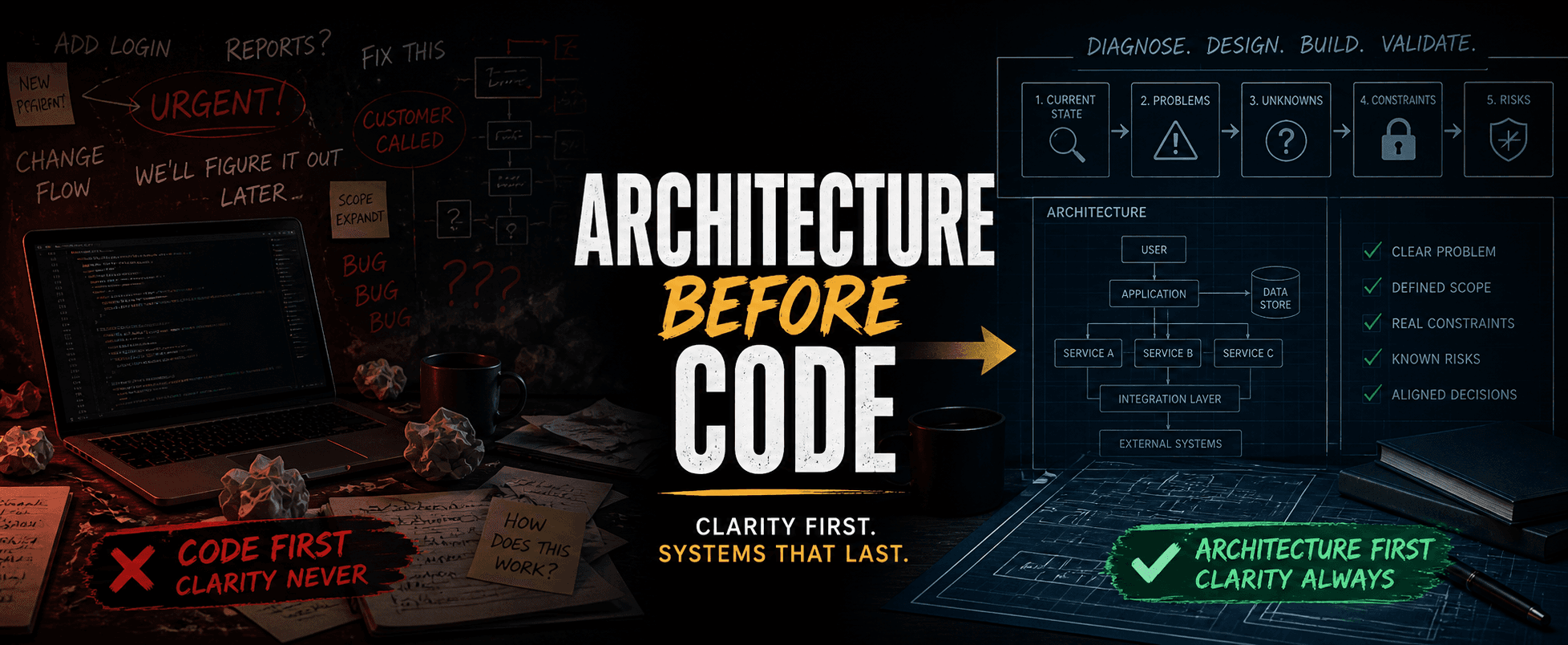
Most projects don’t fail because of bad code.
They fail because:
the system was never clearly defined before implementation started.
And once implementation starts:
ambiguity becomes expensive to undo.
What actually happens
An owner comes in with something like:
“We need a system for our business.”
On the surface, that sounds like a valid starting point.
But in reality, what exists is:
- fragmented workflows
- inconsistent data handling
- undocumented decision rules
- multiple interpretations of “how things work”
- and no shared definition of correctness
So the expectation becomes:
“engineering will figure it out”
That’s where the failure begins.
The input problem nobody names
They don’t come empty.
They come loaded with:
- experience
- intuition
- urgency
- money
Which looks like strength.
Until you try to build on top of it.
Because:
intuition is not a system
experience is biased toward what already worked
urgency is unresolved problems compressed in time
money is pressure pretending to be authority
None of these define reality.
They distort it.
And if you don’t force structure before building:
you’re not engineering a system
you’re formalizing someone else’s confusion
Why this breaks engineering
Engineers usually respond with:
“we’ll start simple and iterate”
That only works when the problem is stable.
But here:
- requirements shift mid-build
- assumptions are invalidated late
- “simple” becomes redefined constantly
- and edge cases appear after implementation
So what looks like iteration is actually:
drifting inside an undefined problem space
What System Diagnosis actually forces
Before any architecture or code, you force clarity on five things:
1. Current State
What actually exists today.
Not documentation. Not intent.
Reality:
- real workflows
- real systems
- real data flows
2. Real Problems
Not opinions.
Concrete failures:
- where systems break
- where data diverges
- where users fail
- where manual work exists to compensate
If it can’t be stated clearly:
it’s not understood yet
3. Unknowns
This is where most projects are already unstable:
- missing definitions
- undocumented logic
- implicit human decisions
- “it depends on the person” behavior
That last one is critical.
“it depends” means there is no system
4. Constraints
Not wishes.
Constraints:
- time
- team size
- technical debt
- operational dependency
- legacy systems
Without this:
architecture becomes fiction
5. Risks
What actually breaks when assumptions fail:
- data corruption
- incorrect decisions
- silent inconsistencies
- system drift
If you don’t map this:
you will discover it in production
What changes after diagnosis
Once this is done properly:
- half the requested system disappears
- most complexity is revealed as unnecessary
- real priorities become obvious
- scope shrinks, but clarity increases
And often:
the original idea is not what gets built
That is not failure.
That is correction.
Why this step gets skipped
Because it has no visible output.
No UI.
No demo.
No immediate reward.
So people skip it.
And pay for it later in:
- rewrites
- delays
- broken expectations
- unstable systems
The real truth
If a system feels chaotic:
it is not an engineering problem
It is a clarity problem that was never resolved before engineering started.
And no amount of code fixes that.
What to do instead
Before writing anything:
- map the real current state
- define concrete problems
- list unknowns explicitly
- define constraints honestly
- identify risks without filtering
And if this cannot be done:
the system is not ready to be built
Final takeaway
Engineering does not create clarity.
It amplifies what already exists.
So if you start from confusion:
you don’t get a system
you get a structured version of confusion